
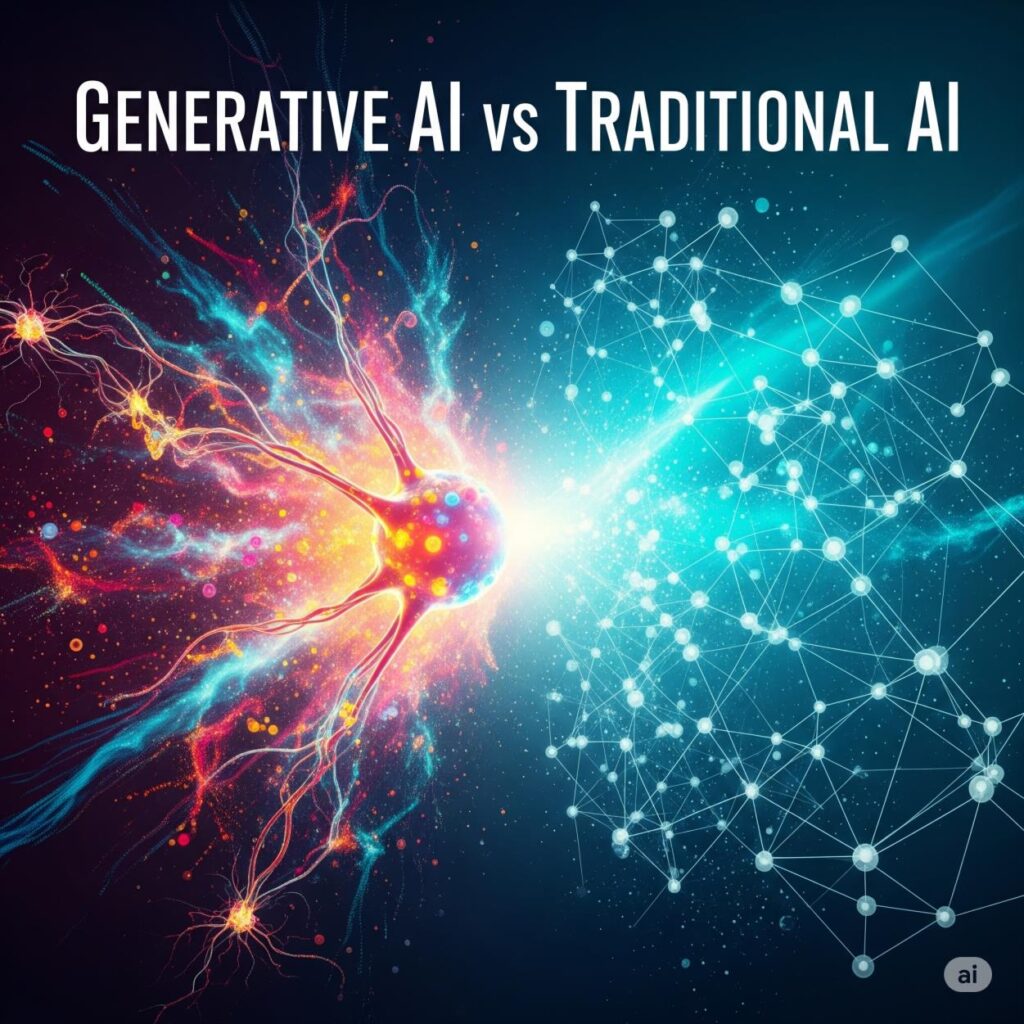
AI is not one-size-fits-all. Understanding the distinction between Generative AI (GAI) and Traditional AI is essential for choosing the right technology for your business goals.
What is Generative AI?
Purpose: To create entirely new content—text, images, video, and more.
Strengths: Innovation, adaptability, and creative output.
Techniques: Uses models like Transformers, GANs, and VAEs.
Applications:
- Content generation
- Product design
- Drug discovery
At FastStrat, we use GAI to automate custom marketing creation and strategy generation—no templates, just tailored outputs.
What is Traditional AI?
Purpose: To analyze data and make predictions based on patterns.
Strengths: Accuracy, consistency, and efficiency in structured tasks.
Techniques: CNNs, RNNs, and reinforcement learning.
Applications:
- Fraud detection
- Medical diagnostics
- Risk assessment
FastStrat also integrates traditional AI to power competitive benchmarking and performance analytics—helping marketers make informed decisions fast.
The Bottom Line
| Generative AI | Traditional AI | |
| Focus | Content creation | Data analysis & prediction |
| Ideal for | Innovation & storytelling | Precision tasks |
| FastStrat uses | Strategy + content automation | Market insights & reporting |
Both forms of AI serve different but complementary purposes. At FastStrat, we combine the creative spark of GAI with the analytical power of Traditional AI—giving marketers the best of both worlds.
You now know what to do. The hard part is doing it every week, without a marketing team, while you run the business.
That is the job FastStrat does: it plans the content, writes it, publishes it, and tells you what actually moved. One place, no stack to assemble.
Start free at app.faststrat.ai →
Set it up in minutes. Keep what works.